This blog is a joint reflection developed through the collaboration between U-Learn, AVSI Foundation, and GiveDirectly. It brings together the perspectives, experiences, and insights of the different partners involved in the work. The piece reflects contributions from across the partnership and highlights shared learning emerging from the collaboration. We gratefully acknowledge the co-authorship and contributions of AVSI Foundation and GiveDirectly.
The blog reflects on how self-reliance has been conceptualised and operationalised in Uganda and on the programmatic pathways actors are prioritising today. It also summarizes the progress made towards reaching the GRF pledge made by the Government of Uganda on resilience and self-reliance. Emphasis is placed on the multi-dimensionality of self-reliance.
Uganda’s refugee response is at a critical moment. As humanitarian funding continues to decline, actors are increasingly forced to make difficult choices about what to prioritise, what to scale back, and what can realistically be sustained. At the same time, there is broad agreement that supporting refugee self-reliance remains essential to enable refugees to live with dignity, agency, and choice – and can at the same time reduce long-term dependence on humanitarian assistance.
Self-Reliance in Uganda’s refugee response: Policy, and practice
Globally, self-reliance has expanded from a narrow focus on livelihoods to a multi- dimensional approach including economic, legal, and social aspects. Programmatic approaches that integrate a range of social and economic inclusion components are increasingly recognised as more effective than single-sector interventions. There is growing acknowledgement that self-reliance programming extends beyond individual and household-level interventions and tackles structural barriers through system-level strategies.
Self-reliance is shaped by a combination of factors, including access to markets and services, legal documentation, social networks, and the ability to engage meaningfully with local and national systems.
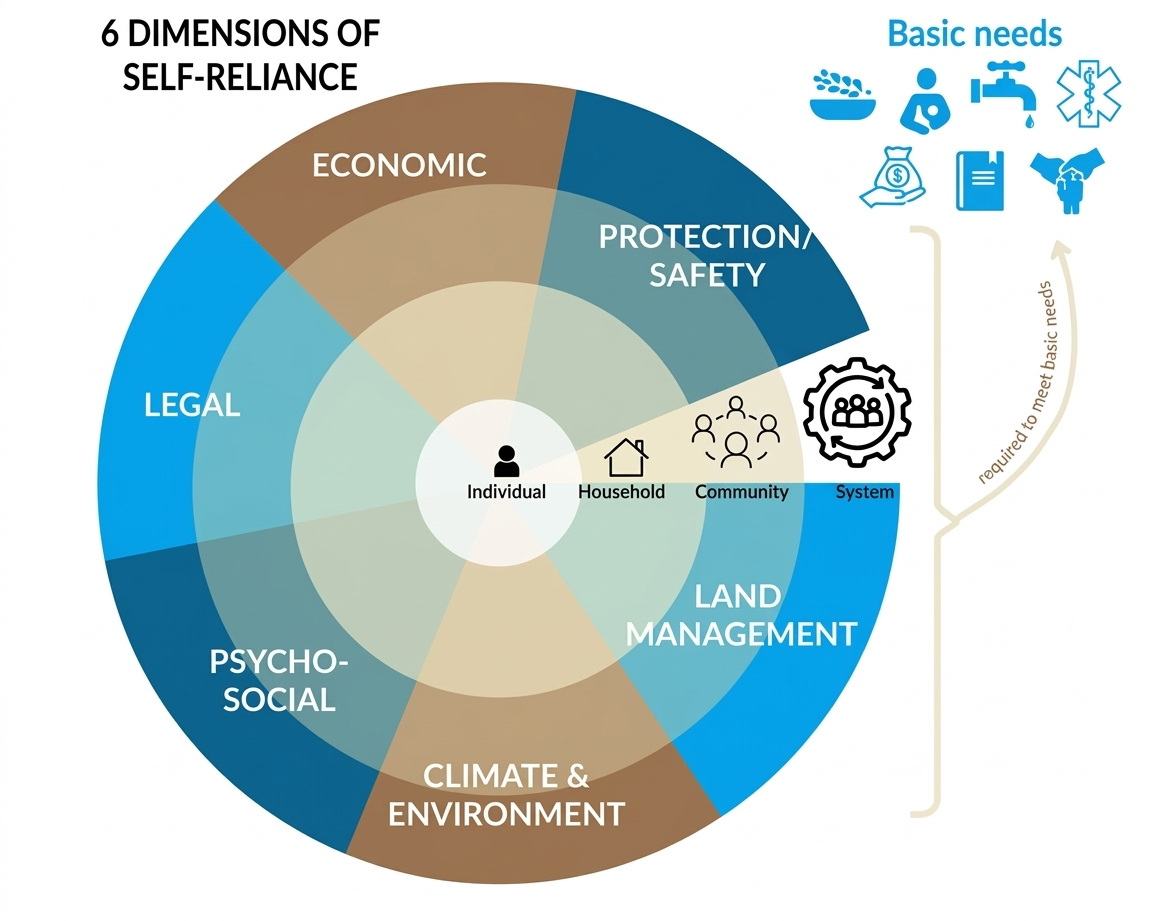
Yet, despite the emergence of multi-dimensional programmatic practices, self-reliance is still frequently equated with livelihoods or income generation alone.
Uganda’s refugee policy framework is widely recognised as progressive. Refugees are granted freedom of movement, the right to work, and access to land and national services, creating a relatively enabling environment for self-reliance. At the Global Refugee Forum in 2023, the Government of Uganda (GoU) made both direct and indirect pledges related to advancing refugee self-reliance, reinforcing this policy ambition and signalling a commitment to longer-term solutions.
The main self-reliance pledge made by the Government of Uganda centres on economic opportunities and reads as follows:
Uganda pledges to create a minimum of 300,000 viable economic opportunities for refugees and host communities by 2027. This shall be realized by including refugees in agricultural value chains, increasing agricultural production and productivity, enabling private sector investments, promoting graduation and market systems development approaches, increasing access to formal and non-formal vocational skills training, promoting the development of market relevant skills and employment creation.”
Other pledges were made under localisation, climate change, etc. However, the linkages are not made directly, and the design and operationalisation of programming towards self-reliance in the refugee response is yet to strongly present self-reliance as a dynamic and multidimensional process.
Progress towards self-reliance
In December 2025, the Government of Uganda published the Mid-term progress review on the Uganda 2023 Global Refugee Forum pledges – outcome report of the national stock-taking events2.
The review classified the self-reliance pledge as being “On Track,” to be reached by 2027 – having achieved 79% of its employment target. It is reported that 223,463 economic opportunities have been generated, benefiting 124,334 refugees and 96,451 host community members.
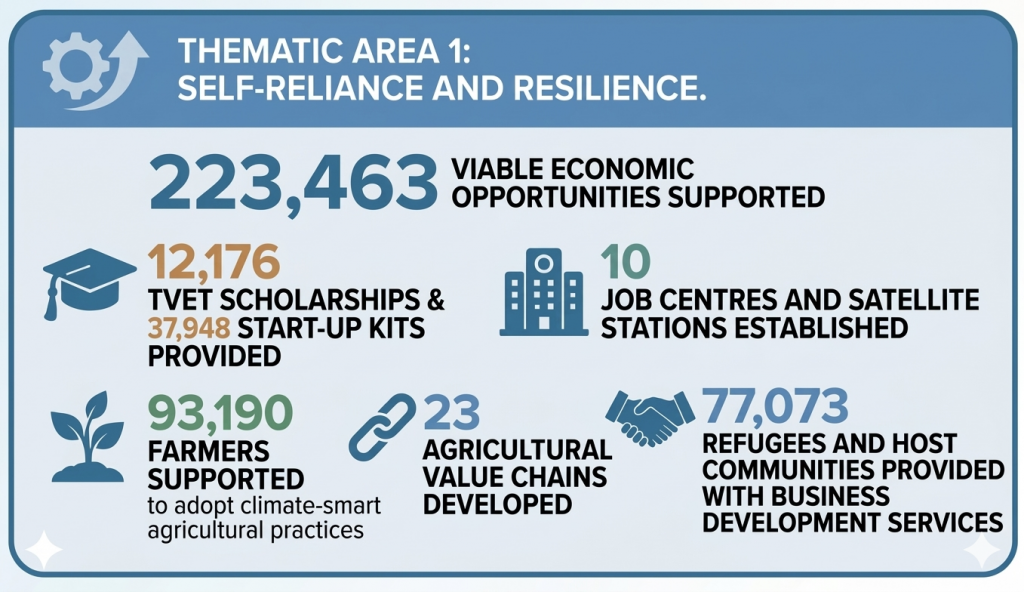
In line with the content of the pledge, the stocktaking focuses on the economic dimension of self-reliance.
However, importantly, it also highlights multiple levels of complementary interventions, spotlighting policy-level and systemic transformation with the development of a national qualification framework to guide the skilling of refugees and host communities and increasing market stall allocations to refugees in hosting districts (now average 39%, significantly outperforming the 10% pledge).
Furthermore, Uganda’s refugee response has made important strides in strengthening how self-reliance is understood and measured. The Government of Uganda launched the Uganda Self-Reliance Index (UG-SRI) on 27th of November 2025 and a baseline analysis of self-reliance.
Despite the GRF pledge being on-track to be met, the UG-SRI baseline analysis showed that as of 2024, less than 20% of the refugee population and host community members have a high level of self-reliance (across all dimensions).
The Government of Uganda conceptualises Self-Reliance as a multi-dimensional process through which refugees and host communities are able to meet their essential needs in a dignified and sustainable manner, with reduced dependence on humanitarian assistance. It encompasses economic participation (livelihoods, income and market access), access to basic services (health, education, WASH, energy and protection), food security and nutrition, social cohesion and inclusion, household agency in decision-making, and resilience to shocks — all anchored within national systems under Uganda’s progressive refugee policy framework.
Rather than defining self-reliance only in economic terms, the Self Reliance Index measures progress across dimensions such as food security, housing and living conditions, access to healthcare, education, economic activity and income, financial resources, social capital and safety, and household agency.
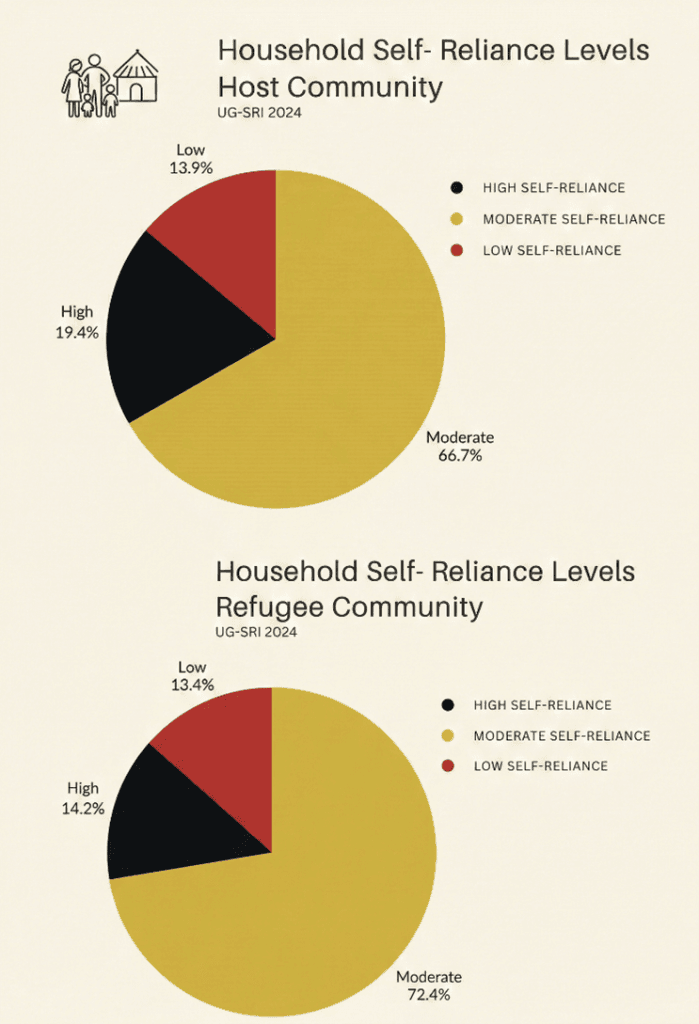
The lowest self-reliance is reported amongst refugee households recently arrived in Uganda, households in the Northern region and single-headed households.
The development of the Self-Reliance Index represents a significant shift away from income-only metrics.
The framework is a national, government-led, standardized measurement and will ensure that all programmes aimed at fostering self-reliance are guided by a unified measurement approach, allowing for effective decision-making and targeted interventions. These multiple dimensions of self-reliance will provide a more nuanced picture highlighting gains or gaps beyond economic considerations – and might be captured in the next review of the GRF.
Barriers to self-reliance identified
In the 2025 stock-taking exercise and in a 2023 in-depth assessment, barriers included:
The barriers to self-reliance commonly observed in refugee settlements [including scale of programmes building self-reliance compared to needs, bureaucratic and financial barriers, limited PSE and access to finance, persistent gender gap, access to market information, secure access to sufficient land.] reflect the interdependency of the different dimensions of self-reliance: Income-generating activities, for example, may be undermined by limited market access, lack of documentation, or weak social networks. Conversely, legal or social gains may not translate into improved wellbeing without economic opportunities.
It will therefore be important that in future stocktaking processes recommendations go beyond considering the economic dimension of self-reliance.

Expert perspective by Rita Larok, Chief of Party, Graduating to Resilience Activity, AVSI Uganda
For more:
VSI Impact in Uganda: https://www.avsi.org/en/who-we-are/impact-results
Programmatic approach: Graduation
In brief: Graduation is a multidimensional sequenced set of interventions based on four foundational pillars: social protection, livelihoods promotion, financial inclusion. It aims for households to graduate, i.e. meet the conditions for self-reliance.
This model is implemented by a range of partners and highlighted as a good practice in the GRF stock tacking outcome report. It is a comprehensive, multi-year approach.
‘It’s incredible to see more than 90% of our targeted extremely poor refugee and host households graduate out of such fragile conditions! Only 18 months before, they lived in fragility and chronic food insecurity. With great self-efficacy, they carry themselves towards a future they desire – and with all the right sets of connections and skills, they are bound to succeed on their resilience journey. The evidence keeps growing. I am a proud Graduation Approach enthusiast, and I urge implementers to get behind these multi-sectoral, time-bound interventions as they change lives. At AVSI Foundation, we have done this already with more than 100,000 households and over 600,000 people and we are committed to moving this to scale!’
Prioritisation under pressure: different programmatic pathways
Evidence from Uganda and global reviews highlights that self-reliance programming works best when it accounts for multiple needs and barriers together, rather than focusing purely on cash transfers, food aid, or economic opportunities alone. However, humanitarian and development actors are increasingly confronted with difficult choices, including the urgent need to prioritise interventions in the face of funding constraints. Which dimensions of self-reliance should be addressed first? Which approaches can realistically be scaled? And how can limited resources be used in ways that maximise both impact and refugee agency?
In response, different programmatic pathways have gained prominence in Uganda’s refugee response.

Expert perspective by Samantha Tinkamanyire, Acting Country Director, Give Directly, Uganda
For more:
Programmatic approach: Large Cash Transfers
In brief: Instead of small amounts of cash meant to cover basic needs at regular intervals, this approach fosters agency by providing single, large amounts to vulnerable persons and allows them to invest in transforming their life and livelihoods. It is a deemed to be cost-effective approach.
‘GiveDirectly’s approach is grounded in a simple idea: larger cash transfers give refugee households the flexibility, dignity, autonomy, and confidence to make meaningful, long-term economic decisions. By providing transformative amounts (around $1,000 per household) families are able to meet immediate basic needs while also investing in productive assets and income-generating activities. Evidence consistently shows that large, lump-sum transfers are more efficient and more likely to support lasting self-reliance than smaller, fragmented payments, which often force households to choose between consumption and investment.’
More examples of programmatic approaches contributing to self-reliance here: https://ulearn-uganda.org/reviewing-the-journey-of-self-reliance-in-the-uganda-refugee-response/
In brief: self-reliance moving forward with a broader lens
In practice, self-reliance programming in Uganda takes many forms, but rarely addresses all dimensions of self-reliance at once. As funding constraints deepen, few programmes are able to tackle the full range of barriers that refugees face. Instead, actors are increasingly required to prioritise.
Taken together, experiences from Uganda’s refugee response point to a clear lesson: all approaches support refugee agency, but they do so in different ways, emphasising different choices, timelines, and forms of autonomy. No single approach fits all households or all settlements.
Outcomes are strongest when multiple dimensions of self-reliance work towards creating, or building refugee agency, even if not by the same actor or within the same programme.
While livelihoods remain a dominant entry point—reinforced by sector strategies and coordination mechanisms that have historically prioritised economic inclusion—they are deeply intertwined with social, legal, and systems-level factors that shape refugees’ real choices and opportunities.
Because no single approach can address all dimensions, generating and using evidence becomes essential—to understand and learn what works for whom, under what conditions, and at what cost. The Self-Reliance Index can help actors navigate prioritisation decisions.
However, donors should not expect rapid return on investment. Evidence compiled by the World Bank suggests that investing in refugee self-reliance makes economic sense and could eventually save donors up to USD 225 million per year. Nonetheless, significant upfront investment is required to bridge poverty gaps for a large share of refugees, at a moment when current aid budgets are insufficient to meet even basic needs. As the World Bank notes, “the costs come before the benefits”.
As resources shrink across the humanitarian system, investing in self-reliance is not optional but essential to reducing long-term dependency and strengthening national systems. Because self-reliance is inherently multi-dimensional — spanning livelihoods, access to services, food security, social cohesion, agency, and resilience to shocks — progress in one area alone is rarely sufficient; integrated and sequenced approaches are needed to drive sustainable outcomes.
In constrained environments, fragmented or single-sector interventions become even less viable, making it critical to prioritise strategies that address interlinked barriers. At the same time, inevitable trade-offs must be guided by robust data, evidence, and continuous learning to determine what works, for whom, and under what conditions, ensuring limited resources are allocated transparently, strategically, and in ways that uphold dignity and equity.
References
U-Learn, 2025: Technical Brief: Reviewing the journey of self-reliance in the Uganda refugee response: https://ulearn-uganda.org/reviewing-the-journey-of-self-reliance-in-the-uganda-refugee-response/
GoU, 2025: https://data.unhcr.org/en/documents/download/120382
Ibid
U-Learn, 2025: Summary of the GoU’s baseline report on the UG-SRI: https://ulearn-uganda.org/summary-of-uganda-self-reliance-index-ug-sri-baseline-report/
ReHope refugee and host Population empowerment Strategic framework – Uganda https://ddrn.dk/wp-content/uploads/2022/12/ReHoPE_Strategy-Report_2017_low-res-3-1.pdf
CRRF Road map https://data.unhcr.org/en/documents/details/74394
Baseline report for the Uganda Self-Reliance Index https://ulearn-uganda.org/uganda-self-reliance-index-ug-sri-for-refugees-and-host-communities-baseline-report/
GoU, 2025: https://data.unhcr.org/en/documents/download/120382 and U-Learn, 2023: Summary of In-depth assessment: The realities of self-reliance within the Uganda refugee context: https://ulearn-uganda.org/the-realities-of-self-reliance-within-the-ugandan-refugee-context-2/
Graduation Compendium: https://ulearn-uganda.org/graduation-compendium-building-a-common-understanding-of-graduation-programmes-in-the-uganda-refugee-response/
U-Learn, 2025: Technical Brief: Reviewing the journey of self-reliance in the Uganda refugee response: https://ulearn-uganda.org/reviewing-the-journey-of-self-reliance-in-the-uganda-refugee-response/
WB, 2024: The Costs Come before the Benefits: Why Donors Should Invest More in Refugee Autonomy in Uganda: https://econpapers.repec.org/paper/wbkwbrwps/10679.htm